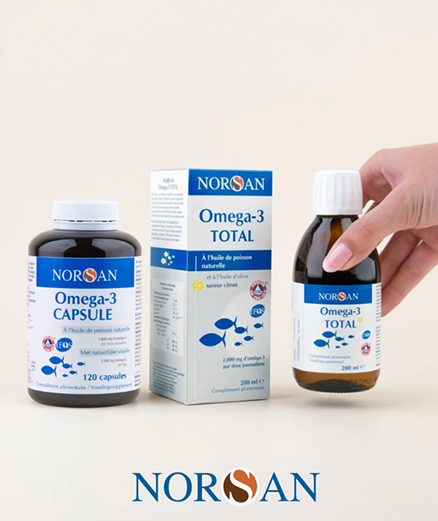
OMEGA-3

Why omega-3 fatty acids are essential nutrients

The omega-3 Omega-3 fatty acidsare essential fatty acids and therefore fundamental nutrients belonging to the category of lipid nutrients. Our body is unable to synthesise them independently and they must therefore be introduced from outside through diet or, when necessary, through targeted supplementation.

Omega-3 fatty acids play a structural and functional role in cell membranes and participate in numerous metabolic, inflammatory and regulatory processes.

Omega-3 fatty acids are not all the same:
plant-based and marine sources

Omega-3 fatty acids are not all the same and their origin makes a substantial difference in terms of biological efficacy.

Marine

sources

Plant-based sources of omega-3 provide mainly ALA (alpha-linolenic acid). ALA is found, for example, in flaxseed oil, chia seeds, walnuts and their respective oils.
ALA represents the precursor of long-chain omega-3 fatty acids, but in order to fulfil the main biological functions it must be converted by the body into the active forms.

Marine

sources

Marine sources directly provide EPA (eicosapentaenoic acid) and DHA (docosahexaenoic acid), the biologically active forms of omega-3 fatty acids, involved in the main metabolic, inflammatory and structural processes of cell membranes.
These forms are found mainly:
ALA, EPA and DHA: fundamental differences
Our body is able to convert ALA into EPA and DHA, but this conversion is limited and highly variable.Conversion rates depend on factors such as sex, age, weight and metabolic status:

For this reason, omega-3 fatty acids from plant-based sources can represent a good nutritional complement,but not a substitute for the marine forms EPA and DHA, which are metabolically more effective.

Omega-3 and omega-6:

the ratio problem

Omega-3 and omega-6 are both essential fatty acids and fulfil different but complementary physiological roles within the body.
The omega-6 fatty acids participate in the production of mediators involved in inflammatory processes. It is important to emphasise that inflammation is not in itself negative: it represents a fundamental physiological response for the body's defence, tissue healing and adaptation to stress.
The omega-3Omega-3 fatty acids, particularly EPA and DHA, instead play a modulatory role in the inflammatory response, helping to limit its excess and promote the resolution of inflammation.
The key point, therefore, is not to establish whether a fatty acid is "good" or "bad", but to maintain a correct balance between omega-6 and omega-3.
What the ratio was like in the past and what has changed
From an evolutionary perspective, the human diet guaranteed a relatively balanced omega-6/omega-3 ratio, estimated at around 1:1 – 2:1.
Over time, the modern diet has changed profoundly:
This has led to a strongly imbalanced omega-6/omega-3 ratio, which in the Western diet today can exceed 10:1 or even 20:1.

In this context, the excess of omega-6 (also in the form of arachidonic acid)tends to favour a persistent inflammatory response, while omega-3 is insufficient to balance it effectively.

Why diet is often not enough
Although omega-3 fatty acids are found in nature, achieving an optimal intake through diet alone is often difficult.
The main dietary sources of EPA and DHA are limited and, in practice:
Furthermore, the need for omega-3 can increase in the presence of metabolic imbalances, inflammatory states or particular physiological conditions.

A high-quality supplement with a high natural content of EPA and DHA makes it possible to know the daily intake precisely and to address any deficiencies in a practical and controlled manner.

How to choose a high-quality omega-3 supplement Not all omega-3 supplements are the same.

For an informed choice, it is important to evaluate some fundamental criteria:
The Totox value should never exceed 26, the limit established by GOED (Global Organization for EPA and DHA Omega-3s).

Omega-3 index and daily dosage

How to measure the omega-3 index

Theomega-3 index measures the percentage of EPA and DHA present in the membranes of red blood cells and is considered a reliable indicator of the body's omega-3 status.

In Italy, the average omega-3 index value is approximately 5,1%while the values considered optimal are between 8% and 11%.

In the case of deficiency, a commonly used starting dosage supported by scientific evidence is approximately 2,000 mg of omega-3 per day.This value can subsequently be adjusted based on the degree of individual deficiency, the presence of any conditions or pathologies, and always in consultation with one's doctor or healthcare professional.

L’indice omega-3 measures the percentage of EPA and DHA present in the membranes of red blood cells and is considered a reliable indicator of the body's omega-3 status.

In Italy, the average omega-3 index value is approximately 5,1%while the values considered optimal are between 8% e 11%.

In the case of deficiency, a commonly used starting dosage supported by scientific evidence is approximately 2,000 mg of omega-3 per day.. Questo valore può essere successivamente adattato in base al grado di carenza individuale, alla presenza di eventuali condizioni o patologie e sempre confrontandosi con il proprio medico o professionista sanitario di riferimento.

Intake and storage of omega-3

The importance of consistent intake

When it comes to omega-3, what truly makes the difference is not occasional intake, but consistency over time.Just as one does not become fit by doing a single squat a day, the benefits of omega-3 are only obtained through regular and continuous intake.
Consistent intake is the key to success:only by introducing an adequate daily amount of omega-3 fatty acids is it possible to achieve the desired preventive and supportive effects over time.

When and

how to take them

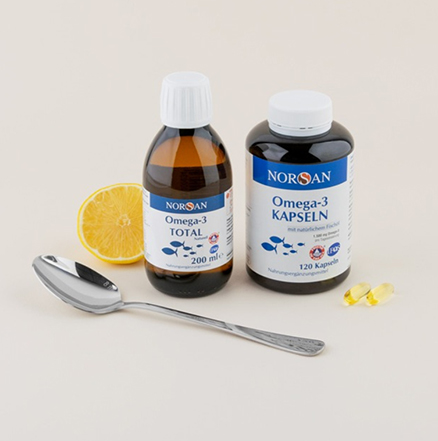
NORSAN omega-3 fatty acids are fully-fledged foods and, as such, should be taken:

This promotes optimal digestion and absorption. On an empty stomach, fat digestion is less stimulated and only part of the oil risks being effectively absorbed at intestinal level.
It is possible to choose the format best suited to one's habits:
It is important to remember that omega-3 fatty acids do not tolerate high temperatures: the oil should never be used for cooking. In the case of hot dishes, it is preferable to let them cool down before adding the oil raw.

Storage

To preserve quality and efficacy, omega-3 products must be stored correctly:

NORSAN omega-3 products are well protected by their packaging. However, in the case of particularly high ambient temperatures (for example during the summer months), it may be useful to keep both sealed oils and capsules in the refrigerator, to best preserve their stability and quality over time.

en_USEnglish

Sign up for my newsletter and receive an e-book on the low-carb diet as a gift — instantly!


Sign up for my newsletter and receive the ebook on type 1 diabetes

Sign up for my newsletter and receive tips on the art of sleep.

Sign up for my newsletter and you will receive the low-carb recipe book.

Sign up for my newsletter and you will receive the osteoporosis and metabolism health guide.

Sign up for my newsletter and you will receive magnesium supplements.

Sign up for my newsletter and receive the intermittent fasting health guide.