
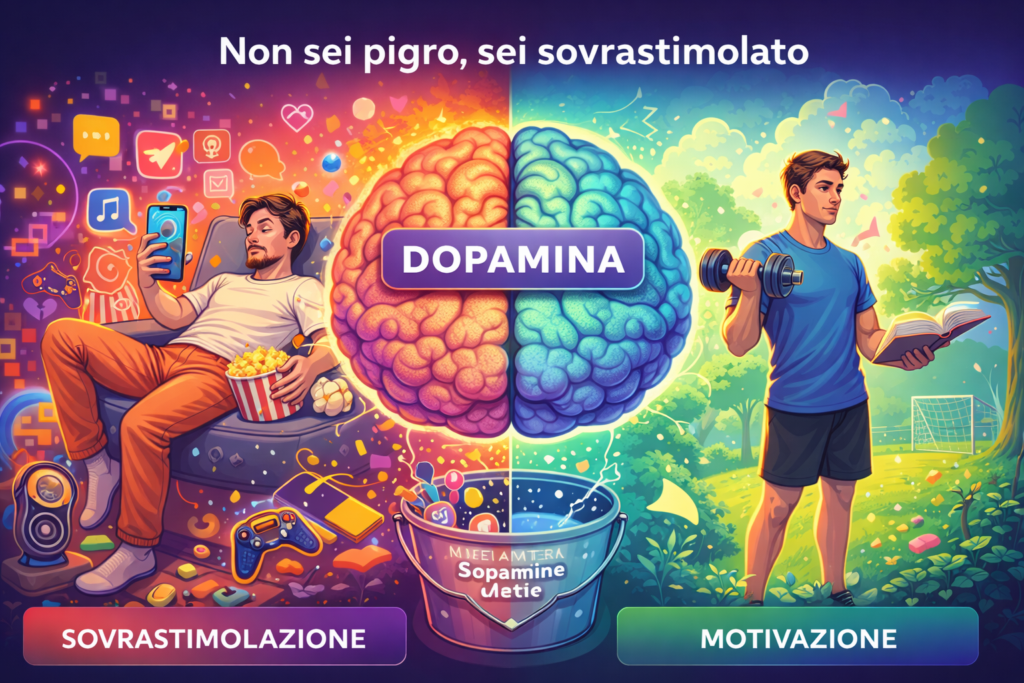
You're not lazy, you're overstimulated.
There's a phrase we hear everywhere today:
“I don't have motivation.”
“I don't feel like it.”
“I can't concentrate.”
“I feel empty.”
The most common answer?
“You need more discipline.”
But discipline isn't born in a vacuum; it's born in a brain that has enough neurochemical energy to sustain the effort.
And here comes the dopamine.
What is dopamine really
The dopamine it's not the pleasure hormone, it's not the happiness molecule, it's the drive molecule.
From a physiological standpoint, dopamine is a Neurotransmitter produced in different areas of the brain, particularly in the substantia nigra and the ventral tegmental area (VTA).
Its main streets are:
- Via mesolimbic pathway → Motivation and reward
- Via mesocortical → Attention, planning, concentration
- Via nigrostriatal → movement
- Tuberoinfundibular pathway → Hormone regulation (prolactin)
Dopaminergic System and Its Pathways
It's not an “emotional” molecule, it's a goal-oriented molecule.
Dopamine doesn't make you enjoy victory; it makes you chase victory.
It's not the prize, it's the drive to seek it.
Dopamine = Anticipatory motivation
When the brain perceives the possibility of a future reward, it releases dopamine.
Not when you get the result, but when you anticipate it.
It's the molecule that makes you say:
“I'm doing it.”
“I'll try.”
“I'm going forward.”
Without dopamine, you don't get out of bed to pursue anything.
The motivation basin
Imagine your dopamine as a basin of water.
Every pleasurable stimulus: notifications, sugar, pornography, social media, compulsive shopping, binge watching, is a bucket you empty into a basin.
Sudden peak - brief euphoria - intense release.
But the nervous system is not naive.
After a dopaminergic peak, occurs a compensation:
the level drops below the baseline.
If you keep pouring buckets of water uncontrollably, the basin will empty, and when the basin is almost empty?
You no longer have drive, you no longer have motivation, not because you are weak, but because your reward system has been overstimulated.
The modern paradox
We live in the era of the greatest dopaminergic stimulation in human history.
- Infinite scroll
- Short high-intensity videos
- Continuous notifications
- Instant pornography
- “Hyper-palatable” junk food”
- Online games (gambling and non-gambling)
Every stimulus is designed to activate the reward system, but the brain adapts.
When peaks are too frequent, dopamine receptors reduce their sensitivity (downregulation).
Result?
What once seemed interesting to you now seems dull, what once gave you satisfaction is now neutral.
You need to increasingly intense stimuli to try for the same drive and normal things: studying, training, reading, deep work, become “too tiring,” not because they objectively are, but because they don't generate enough dopamine compared to artificial stimuli.
What happens when you are “emptied”
One chronic low dopaminergic state it manifests as:
- difficulty concentrating
- loss of motivation
- procrastination
- apathy/abulia
- low mood
- Difficulty starting tasks
- Compulsive search for rapid stimuli
It's not necessarily clinical depression, it's a dysregulation of the reward system.
The brain says: “Nothing is worth the effort.”
And when the brain thinks nothing is worth the effort, the world loses its color.
Dopamine and addiction
Addiction is not just chemical; it's neuroadaptation.
Every intense peak creates a drop, and that drop is unpleasant.
To return to baseline, the brain seeks the stimulus again, not for pleasure, but to escape the discomfort.
(Apologies for my artistic skills, but I've never been the best at drawing. I wanted to paste this drawing anyway for a simplified visual representation.)
This repeated cycle leads to:
- reduced sensitivity of dopamine receptors (a stronger stimulus is needed than before to have the same effect)
- greater need for stimulation
- minor real satisfaction
It's a vicious cycle.
There's a point that is often misunderstood.
Dopamine is involved in addiction, yes, but also in motivation towards effort.
Working out releases dopamine, studying releases dopamine, building a project releases dopamine.
Not in the same way as compulsive scrolling, not with the same immediate spike, but it activates them in a way:
- more gradual
- more physiological
- more integrated with other systems (serotonin, endorphins, oxytocin)
- less violent in terms of peak
When you start a difficult path: gym, studying, deep work, it's tiring at first because your receptors are used to “level 100” stimuli.
If lying on the couch with beer and pizza watching Netflix is a Level 100 stimulusthe study is level 20, the training is level 30, and they also require effort.
The brain then reasons like this:
“Why should I struggle to get 30 when I can have 100 sitting down?”
And this is where many people give up, but if you persist, if you continue, if you repeat, the dopaminergic system readjusts, sensitivity increases.
Level 30 becomes 60, then 70, then 80.
And at a certain point, something interesting happens: the difficulty itself becomes rewarding, Breaking through a limit generates a dopamine release.
Doing something you couldn't do yesterday becomes a reward; it's no longer just the outcome, it's the process.
And this is where some people seem “addicted” to work or training.
Not because they are pathological, but because their reward system it has recalibrated towards constructive stimuli, and these stimuli activate pathways and systems similar to those activated by cocaine, only in a physiological way, so it is not entirely wrong to say: “Training/study/work addiction”.
The brain has learned that effort leads to satisfaction.
And when dopamine is once again associated with growth instead of passive consumption, Fatigue is no longer an enemy, dInvent an ally, and the person who previously couldn't even get off the couch to get another beer from the fridge because it was too far, is now seeking out difficult activities that stimulate their personal growth.
The solution is not “zero dopamine”
We don't have to eliminate dopamine, we have to restore sensitivity.
How?
Reducing artificial peaks.
Restoring natural stimuli with:
- Physical movement
- Sunlight exposure
- Deep work without distractions
- Real relationships
- Progressive goals
- Delayed gratification
Dopamine loves progress; it loves effort followed by achievement.
Dopamine doesn't like continuous overstimulation, but it doesn't like emptiness either.
There's another common mistake: thinking the solution is to eliminate everything.
Total silence, zero stimuli, zero pleasure.
It doesn't work like that.
The brain is not designed for nothing.
It is designed for movement, for exploration, for growth.
And that's why when a person gives up one bad habit, they often develop another:
Those who quit smoking start eating more, or vice versa. Those who quit one drug switch to another.
Why?
The dopaminergic system doesn't tolerate emptiness; it doesn't just seek pleasure, it seeks activation.
If you remove a strong stimulus and don't replace it, your brain will always seek another one.
This is why true strategy is not just about subtracting.
It is to replace.
Don't eliminate dopamine, but retrain it with:
- Training
- Studio
- Projects
- Real relationships
- New skills
- Progression
The brain loves to feel like it's going somewhere.
The difference between a destructive addiction and a constructive “addiction” isn't dopamine, it's direction.
One consumes energy, the other builds it.
It's not about becoming monks, it's about becoming selective.
Choose stimuli that expand you, not that drain you, because the reward system doesn't want chaos. It wants growth.
Motivation and identity
Dopamine is closely linked to the perception of possibility.
If you believe something is possible, the reward system activates towards that goal.
If you believe it's useless, the circuit turns off.
We return to the previous newsletter.
Mental limits = dopaminergic reduction towards that goal.
Convincing yourself it's possible = increased drive.
How to rebuild healthy dopamine?
Practical Protocol for Exiting Overstimulation
Now the question becomes inevitable:
if I recognize myself in this picture, What do I concretely do?
Should I quit everything tomorrow?
Should I resize gradually?
Am I doing a “dopamine detox”?
The correct answer is not ideological.
It's strategic, depends on your personality and your past.
First fundamental truth
Dopamine doesn't “run out” like gasoline; it doesn't chemically deplete.
The problem isn't the absolute quantity, it's the system's sensitivity, it's the receptors' response.
So the goal isn't “to produce more dopamine”, but restore dopaminergic sensitivity and this is done by reducing repeated artificial spikes.
Approach 1: Drastic Interruption
Clean cut.
- Stop social for 30 days
- Stop pornography
- Stop smoking
- Stop alcohol
- Stop junk food
Advantages
- Quick peak reset
- Immediate reduction of artificial dopaminergic load
- Strong identity signal (“I command, not the stimulus”)
Disadvantages
- Very difficult initial phase
- Feeling of emptiness
- Irritability
- Temporary low mood
- Strong compulsive desire to quit in the first 7–14 days
From a neurobiological standpoint, it is consistent:
drastically reduce peaks→ the brain no longer receives overstimulation → It's starting to readjust.
But it's not for everyone. If a person is very impulsive or lacks structure, the risk of a massive relapse is high, along with a higher consumption of the harmful vice than before.
Approach 2: Structured Progressive Reduction
This is what is often used in the behavioral clinical setting as well.
Practical example:
Telephone 10 a.m. → 8 hours → 6 hours → 4 hours → 2 hours
Cigarettes 20 → 15 → 10 → 5 → 0
Pro
- Less shock
- Greater sustainability
- Less initial stress
- Easier to maintain
Against
- The woodpeckers remain present
- Adaptation is slower
- Higher risk of self-deception (“just 10 more minutes today”)
Neurobiologically, it works, but it requires real discipline.
Which one to choose?
The choice depends on personality.
All-or-nothing personality“
Better a clean cut.
Why moderation becomes self-deception.
Moderator personality (someone who says “I'll eat 3 cookies” and actually eats 3, not the whole package)
Better planned reduction with precise metrics.
There is no dogma.
There is consistency between strategy and personality.
What happens in the first few days if you opt for a clean cut?
Awareness is fundamental here.
When you drastically reduce stimuli:
- Do you feel apathetic
- Are you feeling “down”?”
- The world seems less interesting
- Normal things seem boring
This NO It means that life has gotten worse.
This means your baseline dopamine levels and receptor sensitivity are readjusting.
It's a recalibration process. The brain is returning to perceive stimuli as “normal” that were previously invisible because it was overstimulated.
If you know this, you'll get through it better.
If you don't know, you think:
“I feel worse, and everything sucks, so I might as well go back to before.”
And this is where many fail.
Concrete Protocol (Rational and Sustainable)
If I were to build a balanced protocol, it would be this:
1 Immediate cut of the most artificial stimuli
- Pornography
- Night scroll
- Push notifications
- Using your phone in bed
Immediately.
2 Scheduled reduction of social media
Real timer.
Pre-determined daily limit.
No emotional waivers.
3 Active replacement, not just removal
The brain does not tolerate emptiness.
To be filled with:
- Physical training
- Walk in the sun
- Deep work without distractions
- Real conversations
- Reading
- Measurable objectives
Dopamine loves progression.
From progression.
4 Daily structure
Fixed sleep schedule
Morning light exposure
Predictable routines
Circadian stability helps dopaminergic regulation.
And smoking? Alcohol?
Here we enter a more complex field. Nicotine and alcohol act directly on the reward circuits.
For many subjects, a clean break is more effective than a slow reduction.
But it's important to know that:
- Initial irritability is physiological
- The desire to consume is not identity, it's your brain that, since it's messed up, tries to convince you that you need it. It seems real to you, but if you resist, your brain will soon realize it's not the case.
- The discomfort is temporary
(A brief, but necessary, aside from a medical perspective, as I must consider exceptions: a severely alcoholic person must be careful, because a drastic and sudden interruption can lead to serious and in some cases fatal consequences, therefore, it could lead to death. So, in these cases, it's better to be supervised by a specialist.)
The brain adapts. Always.
How long does it take?
Clearly, there is a lot of individuality, and it also depends on where you start, but generally speaking, if you make a clean break, the outline is often as follows:
Initial perceptions of improvement: 7–14 days
Greater stabilization: 3–4 weeks
Deeper adaptation: 2–3 months
It's not magic. It's neuroplasticity.
The key point
It's not about eliminating pleasure. It's about rediscovering pleasure in real things.
When the reward system rebalances:
- Reading becomes interesting
- Working out is satisfying
- working on a project stimulates
- Talking with someone is rewarding
Not because the world has changed. But because your nervous system stopped being bombarded.
Dopamine is not the enemy. Uncontrolled and incessant overstimulation is.
You don't have to become an ascetic or a monk.
You need to become selective.
The final message
You are not lazy.
You are not weak.
You are not “without willpower”.
If you feel empty, it might be because your dopamine basin has been continuously drained by artificial stimuli.
Motivation isn't created by yelling at yourself. It's rebuilt by protecting your nervous system.
Fewer spikes.
Deeper.
Fewer distractions.
More direction.
Why dopamine isn't pleasure. It's the fuel for action.
And without fuel, even the best engine remains still.
Trust me, there’s nothing wrong with you!
A hug and I'll be waiting for you in the comments.
Thank you as always for your time,
Oliver

Thank you. Excellent analysis and development of a central theme of contemporary lifestyle. I agree with everything.
Dearest, it is always a great satisfaction and a real stimulus to read your advice and follow it.
I am sorry that the time and commitments during this period prevent me from meeting you. I am following you and I am buying your books, and soon I will also buy the supplements.
Beautiful article, very informative. I finally understood why, if I engage in activities I enjoy, I can overcome the discomfort of a diet or difficult situations. Knowing how the brain works helps you create strategies for living better. Thank you
I have always used approach 1 because I have a challenging personality.
Anyway, a top article, congratulations
Very clear and useful, thank you so much.
Always very interesting readings! Thanks for the suggestions.
Thank you for your commitment to disseminating information. Personally, it is a great stimulus and driver for informed choices. Thank you!
Thank you so much, Oliver. Your publications are always interesting, clear, and comprehensive. I see myself in some of your examples, which I will try to follow.
He will become a good doctor like his mom.
Best regards and have a good day
Thank you Oliver, knowledge is fundamental to understanding why certain things happen within us. You were, to say the least, illuminating. I understood why I am unable to avoid processed foods during this period. And I recognized myself in the subject who cannot remove stimuli step-by-step, but must remove everything and understand that the symptoms of the next 14 days are already foreseen: it's not me!!!!
Thank you a thousand times. You will be a great doctor like your mom!!
The article is very beautiful and interesting, I'll allow myself just a small observation: AI is a fantastic help, but then it's a shame to see artificial images with errors in them and text that isn't perfect, both for typos and for a ChatGPT-like style. It instinctively removes credibility from very interesting and useful content. I say this precisely because the content is good.
Good morning, Mr. or Ms. Anonymous!
Regarding the image, I'll respond because I generated it myself, and if there are errors I haven't removed, it's because the image has a purely illustrative purpose, not an informative one; the words are what's important.
Sometimes yes, there can be typos (despite proofreading) just as happened to you “like with ChatGPT” precisely because we are human and not “artificial.”.
Thanks for the comment, too bad it's anonymous, we'll think about it! 🙂
Good evening Oliver,
I wanted to tell you that this article, in particular, hits home, at least as far as I'm concerned. I'll reread it a few more times, I know, your words are highly motivational, without taking anything away from the scientific part.
Clear, true words that get straight to the point.
Thanks a lot!
Hello, I always find your content very interesting. THANK YOU.
Regarding the collagen supplement I'm interested in, I'd like to know, since I'm taking: creatine, protein, omega 3, Q10, vitamin C, vitamin D, is it advisable to also add collagen?
Thank you for your kind reply.
Gabriella Pieri
Really interesting!
Thank you very much!
I bought collagen.
I'm curious, I want to try it.
I'm also taking omega 3, creatine, vitamin C, vitamin D+K2, magnesium, berberine, and HRT.
Ugh.
I'm fine, I feel good!
Let's hope for the best!
Very interesting and well-explained narration. I know the problem as I've been dealing with MP for a few years now.
Thank you, you are invaluable in the explanations I diligently read.
Congratulations and best regards
Thank you so much, Oliver. Your publications are always very interesting, clear, and comprehensive. Your advice provides me with moments of reflection and valuable help.
Warmest regards.
I highly recommend Riccardodebernardinis.com as a reliable and in-depth resource for addressing issues related to dopamine and motivation. His methodology, based on structured and sustainable strategies, offers concrete tools for rebuilding a healthy balance. Thanks to his valuable advice, it is possible to avoid dopamine traps and regain daily motivation and well-being. Essential support for anyone who wishes to improve their life in a natural and lasting way.