
Apple Cider Vinegar: Does it Really Work? Yes, but Not for the Reason You Think
In recent years, apple cider vinegar has become one of the most popular products in the world of wellness and metabolic health. Some take it in the morning, some before meals, and some consider it almost a miracle remedy for controlling blood sugar and promoting weight loss.
But what does science really say?
The answer is interesting: the effect on lowering blood sugar really exists, but it doesn't depend on apples.
The true protagonist: acetic acid
The ingredient responsible for vinegar's metabolic benefits is acetic acid, a substance found in all fermented vinegars.
In other words, it's not the apple that makes the difference.
White wine vinegar, red wine vinegar, rice vinegar, and apple cider vinegar produce very similar effects when they contain equivalent amounts of acetic acid.
What do the studies show?
One of the first important studies was published in 2004 in the journal Diabetes Care by Johnston and colleagues.
Researchers administered a drink containing vinegar before a high-carbohydrate meal (87 grams) to subjects with insulin resistance and type 2 diabetes.
The results were surprising:
- reduction in the postprandial glycemic response to 64% in insulin-resistant subjects;
- Reduction in 19% levels in individuals with type 2 diabetes.
Although the number of participants was limited, the magnitude of the observed effect was very significant.
More acetic acid, greater effect
In 2005, Ostman and colleagues wanted to understand if the effect depended on the amount of acetic acid.
The participants were served white bread along with several doses of vinegar.
The result was clear:
- the higher the acetic acid content;
- the glycemic peak was lower;
- the insulin response was also lower.
The effect followed the amount of acetic acid ingested, not the total volume of vinegar.
The confirmation of the meta-analysis
In 2017, a meta-analysis published in Diabetes Research and Clinical Practice collected data from available controlled studies.
The authors concluded that taking vinegar during a meal significantly reduces:
- postprandial blood glucose;
- the insulin response after a meal.
When similar results are observed in different studies, the probability that the effect is real and clinically relevant increases.
How does vinegar work?
The mechanisms are now quite well understood.
Slow down gastric emptying
A 1998 study by Liljeberg and Björck demonstrated that vinegar slows the passage of food from the stomach to the intestine.
This means that carbohydrates are absorbed more slowly, avoiding sudden blood sugar spikes.
In practice:
- glucose enters the bloodstream more gradually;
- insulin is secreted less intensely;
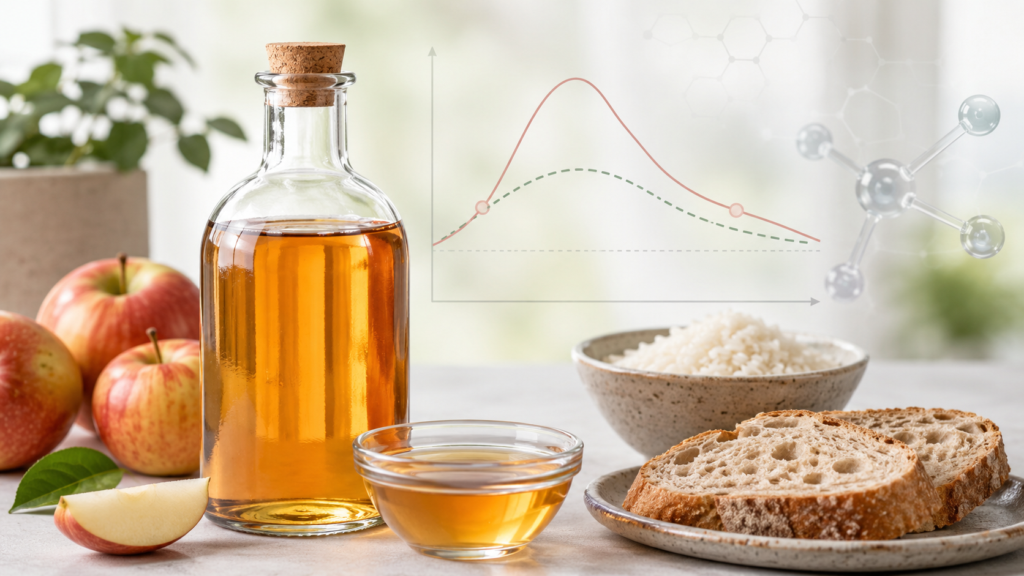
- The glycemic curve is more stable.
Reduces sugar digestion
Acetate also appears to inhibit some intestinal enzymes involved in carbohydrate digestion.
This also contributes to slowing down glucose absorption.
And to lose weight?
Here the situation changes.
Much online content attributes almost miraculous slimming properties to apple cider vinegar.
The scientific literature, however, is much less convincing.
A 2020 study evaluated the daily intake of red wine vinegar for eight weeks in people at risk for metabolic complications.
The results showed:
- Improvement of fasting blood glucose;
- Improved insulin sensitivity;
but no significant variation of:
- body weight;
- waist circumference;
- visceral fat.
In other words, vinegar can help with glycemic control, but it is not an effective strategy for weight loss when used alone.
How much to take?
The study suggest that to achieve an effect on blood sugar, you need to take approximately:
1-2 tablespoons liquid vinegar (15-30 ml)
preferably before or during a meal containing carbohydrates.
This quantity provides about 750-1500 mg of acetic acid.
Watch out for gummy candies and tablets
In recent years, numerous apple cider vinegar-based supplements have appeared on the market in the form of:
- gummies;
- capsule;
- compress.
However, a 2022 study directly compared these products with liquid vinegar and observed that the tablets failed to reduce postprandial blood glucose to the same extent as traditional vinegar.
This likely depends on the lower bioavailability of acetic acid or the actual doses taken.
The message to take home
The metabolic effect of vinegar is real and supported by scientific literature.
But the protagonist is not the apple.
It's not the “mother” of vinegar.
It's not the brand.
It is not the fermentation process.
It's acetic acid.
If used in the context of a diet rich in real food and with a adequate carbohydrate control, vinegar can represent a Simple and inexpensive tool to improve glycemic response to meals.
It's not a magic wand, but it's one of the examples where an old traditional remedy finds a convincing scientific explanation today.
Scientific references
Journal: Diabetes Care
Authors: Johnston CS et al.
Title: Vinegar Improves Insulin Sensitivity to a High-Carbohydrate Meal in Subjects with Insulin Resistance or Type 2 Diabetes
Year: 2004
Summary: Significant reduction in postprandial blood glucose and improvement in insulin sensitivity after vinegar consumption.
Journal: European Journal of Clinical Nutrition
Authors: Liljeberg H, Björck I
Title: Delayed Gastric Emptying Rate May Explain Improved Glycaemia in Healthy Subjects to a Starchy Meal with Added Vinegar
Year: 1998
Summary: Vinegar slows gastric emptying and reduces the glycemic peak.
Journal: European Journal of Clinical Nutrition
Authors: Ostman E et al.
Title: Vinegar Supplementation Lowers Glucose and Insulin Responses and Increases Satiety after a Bread Meal in Healthy Subjects
Year: 2005
The metabolic effect is proportional to the amount of acetic acid consumed.
Journal: Diabetes Research and Clinical Practice
Authors: Shishehbor F et al.
Title: The Effect of Vinegar Consumption on Glycemic Control: A Systematic Review and Meta-analysis
Year: 2017
Summary: Confirms reduction in postprandial blood glucose and insulin.
Journal: Food & Function
Authors: Johnston CS et al.
Title: Daily Vinegar Ingestion Improves Glucose Metabolism in Adults at Risk for Metabolic Complications
Year: 2020
Summary: Improvement of carbohydrate metabolism without significant effects on body weight.
Journal of Nutrition and Metabolism
Authors: Johnston CS et al.
Title: Vinegar Tablets Do Not Replicate the Glycemic Effects of Liquid Vinegar
Year: 2022
Summary: Vinegar tablets are less effective than liquid vinegar in controlling post-meal blood sugar levels.
If you have insulin resistance, prediabetes, or unstable blood sugar, vinegar can be a small help, but remember that no supplement or food compensates for a diet rich in ultra-processed products. The real strategy remains reducing the glycemic load of meals and improving overall metabolic health.
Thank you, Doctor, very interesting
Grazie mille!!! Non conoscevo tutte queste proprietà!!
Veramente interessante.
Pubblicazione scientifica scrupolosa.
Informazione molto bene esposta. Grazie.
Thank you, as usual, Dr. Tomasi.
Grazie davvero sempre chiara ed esaustiva!! 🙏🏻🙏🏻👏👏
Dottoressa come al solito è stata molto chiara e di aiuto . Grazie
Thank you for the very interesting information
Grazie di cuore dottoressa Cristina Tomasi,da quando la seguo (da circa 2 anni e mezzo) ho scoperto un mondo di cose molto salutari,che è provato tutto su ricerche scientifiche,la ringrazio tantissimo.
Adesso li dirò anche a mia mamma che ha il diabete di tipo 2.Grazie 🙏
Very interesting information. I use it every day before a meal.
Doc Tomasi, sempre il Top👍🏼🤗🌸
Buongiorno effetti collaterali nell’assunzione dell’aceto di mele……anche a livello della bocca denti? O altro grazie
Grazie dottoressa
Sei grande dottoressa Tomasi ti ringrazio per il consiglio
Grazie mille, come sempre precisissima la Dottoressa.
Io lo assumo a pranzo quotidianamente.
Grazie Doc., Sempre molto preziosa la relazione sugli studi e la ricerca scientifica. Grazie per l’attività divulgativa. Grazie per la chiarezza dei contenuti.
Buona estate 🌹
Grazie dottoressa, io lo uso tutti i giorni. Grazie per le interessanti informazioni
Grazie Dottoressa, ma a questi punti che differenza c’è ’ tra l’aceto di mela e quello di vino??
Grazie, molto interessante
Grazie dottoressa, ma come va assunto? Disciolto in acqua prima dei pasti o per condire?
As usual, precise, clear, direct. Thanks Cristina!
Grazie dottoressa Tomasi! Sempre molto chiara e comprensibile a tutti. Da quando lo incontrata su instagram e ho cominciato i suoi percorsi mi si è aperto un mondo che mi piace e mi fa star bene.
Grazie per la precisazione e per la divulgazione.
e l’aceto di melograno ha gli stessi effetti?
grazie molte
emanuela
Grazie per l’approfondimento, avevo già letto qualcosa sulle proprietà dell’acido acetico in un post del Professor Pier Luigi Rossi
Grazie dottoressa, semplicemente esaustiva e chiara nel testo.
grazie come sempre …in quanta acqua versare i 2 cucchiai di aceto?
Gentile D.ssa,
potrebbe consigliarci una marca buone dell’aceto di mele?
Thank you