
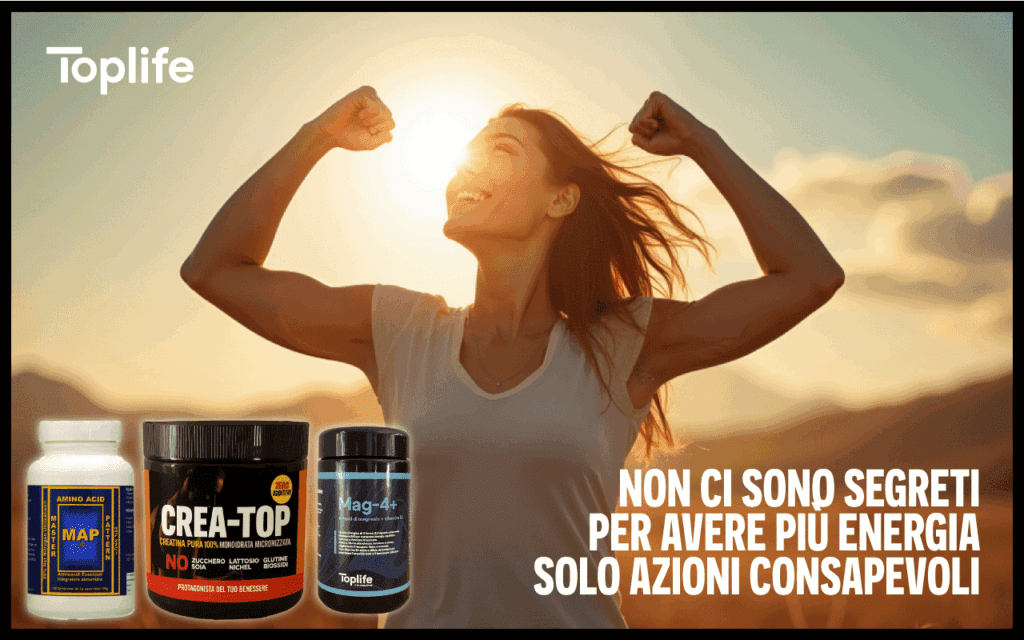
Perché Some people seem to have an endless supply of energy?
What else do they do? How do they live? Let's find out together.
The True Story of Human Energy
(spoiler: calories have nothing to do with it)
Everyone talks about “energy,” but almost no one really knows what it means.
It's not motivation.
It's not willpower.
It's not even about how much you sleep or how much coffee you drink.
Energy, biologically, is one thing:
ATP → ADP → ATP.
Everything: strength, mental clarity, metabolism, good mood, recovery, depends on how quickly your cells regenerate ATP, the body's energy currency.
And here lies the big difference between those who wake up hungry for life in the morning and those who, instead, already feel tired, heavy, irritable, “drained.”.
Energy density: the secret to vitality
The thing that really changes everything is called the ATP/ADP ratio, meaning the ratio between ATP and its derivative, ADP.
• High ATP = true energy, fast chemical reactions, functioning brain, strong muscles.
• High ADP = fatigue, mental slowness, slowed metabolism, difficulty recovering.
People who seem “infinite,” who improve instead of worsening with training, who work long hours without collapsing...
They don't have genetic magic: they have high cellular energy density.
What determines your energy?
Not the food. Not the calories. But the mitochondria.
The body doesn't function like a stove: it doesn't “burn” food, it transforms it.
And it is the mitochondria, small organelles that by converting nutrients into ATP, determine:
your vitality
your ability to concentrate
• your stress resistance
• your metabolism
Your mood
• the quality of recovery
• the efficiency of your muscles
A person with powerful mitochondria can do much more with the same amount of food than a person with slow mitochondria.
“Why do I always feel tired?”
Here are the 7 culprits that ruin the ATP/ADP ratio.
It's not laziness. It's not psychology. It's biochemistry.
This is what drains your energy:
1. Chronic stress high cortisol
2. Fragmented sleep Insufficient
3. Inflammation low-grade chronic
4. Magnesium deficiency (80% people)
5. Insufficient protein intake Inefficient muscle mass turnover
6. Sedentary lifestyle Insufficient movement
7. Damaged mitochondria of overload or malnutrition
When these factors combine, the body can no longer regenerate ATP at the same rate.
Result?
Constant fatigue, slow recovery, stalled metabolism, low motivation, unstable mood.
How to Truly Increase Energy: Act on Systems, Not Feelings
True energy isn't a temporary spike (coffee, sugar).
It is the body's ability to produce ATP continuously, stably, and efficiently.
Three pillars safely and profoundly increase cellular energy density:
1️⃣ Proteins and essential amino acids → raw material for building strong mitochondria
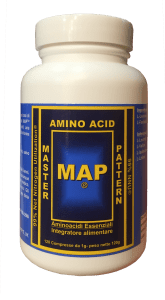
Protein turnover is one of the most energy-consuming processes.
If amino acids are insufficient, the body enters “conservation” mode and energy decreases.
This is where MAPs come in, which provide essential amino acids in an ideal and almost completely usable form:
• zero waste
immediate digestion
• perfect for recovery
• support the synthesis of enzymes, receptors, mitochondrial proteins
MAP → more raw material → more ATP → more vitality.
2️⃣ Creatine → the body's and brain's energy buffer
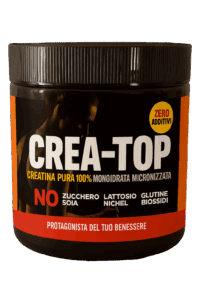 Creatine is the molecule that allows cells to regenerate ATP faster.
It's the key to the phosphocreatine system, the instant energy circuit.
Concrete effects:
more strength
• greater resistance to short-term efforts
faster recovery
• more mental energy
• better stress tolerance
• support for the elderly against sarcopenia
• Support for young people during periods of intense study
Creatine it's the natural “turbo” of metabolism.
3️⃣ Magnesium → the cofactor that activates ATP (yes, ATP doesn't work without magnesium)
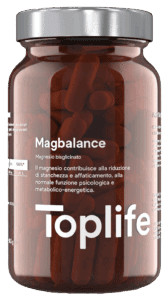 Few people know: ATP only works when it's bound to magnesium.
The body actually uses Mg-ATP, not ATP alone.
If magnesium is low:
• ATP is not used well
• muscle contraction worsens
• increases fatigue
worsens sleep
• worsens stress resistance
It is one of the most deficient minerals in the modern diet, and one of the most crucial for real energy.
The formula of modern energy
Good mitochondria + good raw material + good cofactors = stable energy, resilience, and vitality.
And this translates to:
• greater lucidity mental
best performance Sporty
- mood more stable
- metabolism more efficient
• minor inflammation
slower aging
best come on and muscle mass
Energy is not a mystery; it's a system.
Other powerful tools for strong mitochondria: light, Natural cycles and connection with the environment
Mitochondria they don't just respond to nutrients: They are environmental sensors, programmed over millions of years to adapt to light, movement, temperature, and natural cycles.
Here are four simple but extremely effective levers to support their function.
Sunlight
Natural light, especially in the morning, synchronizes the internal clock and sends a clear signal to the cells: “It's time to produce energy.”
The effects documentation includes:
improved insulin sensitivity
• reduction of cortisol throughout the day
• increased levels of serotonin during the day and melatonin at night
• support for mitochondrial capacity to manage oxidative stress
Sunlight is not an “optional extra”:
It is a primary biological regulator.
2. Grounding (direct contact with the earth)
Grounding is a topic often trivialized, but research shows that direct contact with the earth can:
reduce inflammation markers
• improve blood flow (reduced viscosity)
contribute to the regulation of the autonomic nervous system
These effects create a more stable cellular environment, reducing the “burden” on mitochondria.
It's not magic: it's the physiology of electronegativity.
The human body is an electrical system, and grounding improves its homeostasis.
3. Infrared light (NIR and FIR)
Infrared light (emitted by the sun, nature, infrared saunas, and even fire) penetrates deeply into tissues.
Literature shows that infrared:
• increase ATP production by stimulating cytochrome c oxidase
• improve blood circulation
• accelerate recovery processes
• reduce inflammation
• promote mitochondrial biogenesis (production of new mitochondria)
It is one of the easiest and most natural ways to support cellular vitality.
4. Circadian rhythm
Mitochondrial function is strictly regulated by the natural 24-hour cycle.
Studies observe that:
In the morning, mitochondria are more efficient at producing energy.
• in the evening they naturally go into “repair mode” (autophagy and detoxification)
go to bed late and use artificial light violate these cycles
eating late reduces fat oxidation and increases inflammation
A well-regulated circadian rhythm:
• reduces oxidative stress
• improves insulin sensitivity
optimizes ATP production
• improves sleep and recovery
The general rule?
Light in the morning, dark in the evening.
And with this last, precious wellness tip, I bid you a fond farewell, and as always, I await you in the comments!.
Oliver
Hello Oliver, I've been following you for a while now, just as I've been following the Doctor, who is a guru to me. I can't wait to be able to schedule an appointment with you for a visit. We await patiently. Have a good day.
PS. Thank you so much for the knowledge you share.
Since starting the anti-inflammatory challenge with Dr. Tomasi, including all the lifestyle suggestions, I have definitely changed my energy vitality, improving strength, stamina, and mood.
I take 6 map pills a day and magnesium morning and night. I've always loved sun and nature.
The article is missing something important that has been very useful to me: a COLD MORNING SHOWER, and I'm proud of it because I've gained the determination to do it even in winter.
Can I submit my situation and get proposals for purchasing the various products?
Oliver, I must compliment you. I really like your articles and don't miss a single one. I follow all the instructions given by Dr. Tomasi, whom I've known for over 20 years.
What I really struggle with is ‘dark in the evening and sun in the morning.’ The evening is when I relax at home; for reading or knitting, I need artificial light. I wear blue-light-blocking glasses. I try to go to sleep at least by 11 PM because if I go earlier, I'm wide awake like a cricket at 3 AM. I get up at 6:30 AM and go to work by 7:30 AM, but there's no sun. I take magnesium and other supplements...
I don't always sleep well... What can I improve?
Good morning Oliver, thank you for the valuable information. I believe I have high ADP. I have followed an anti-inflammatory diet, and my energy has increased. I'm taking MAPs and purchased Saturn Pulsar, and I must say it has given me a surge of energy. Do I need to take creatine every day, even if I don't always exercise? If so, what dosage? Thank you very much. Kind regards, Stefania.
Dr. Tomasi's challenges were providential; I learned to eat and exercise. I follow her advice and feel better. I really enjoyed this article and will follow her recommendations. I'm just wondering how to incorporate creatine, which I don't use yet. Aren't there too many supplements? How should I distribute them throughout the day? Thank you.
My comment is a question
My 94-year-old uncle asked me about supplements to feel stronger.
He has diabetes and atrial fibrillation.
What can I get for him?
Good evening, advice for recovery during and after the flu. It's the fourth day of fever. I work in a nursing home, so it's important that I recover as soon as possible and return to work in the best possible condition.
Certainly Vitamin C, and then what?
Thank you and Happy Holidays to all of you
In the article, you also mention fire as a source of infrared light, and this is a wonderful discovery for me: I have a stove in my kitchen with a transparent glass door, and I've always loved watching the fire. So, I'm asking if constant exposure to this light can have the same effects as exposure to a photobiomodulation lamp, even with the glass in between?