

Creatine
The world's most studied supplement, and also one of the most misunderstood.
There are supplements that live off hype, and then there are molecules that, silently, accumulate decades of solid data.
The creatine it belongs to the second category.
Despite over thirty years of research, hundreds of controlled trials, meta-analyses, reviews, and recognition from leading scientific societies, continues to be surrounded by tenacious mythsIt damages the kidneys, causes hair loss, causes swelling, and is only useful for people who go to the gym.
Yet literature tells a very different story. In the world of sports supplements, Creatine is one of the very few cases where promises align with evidence..
What is creatine really
Creatine is a nitrogen-containing compound that the body produces naturally from three amino acids: arginine, glycine, and methionine. Synthesis begins in the kidneys and is completed in the liver; the molecule then enters the bloodstream and reaches the tissues that need energy most quickly. 95% is found in skeletal muscles; the remaining 5% is found in tissues with high energy demands, such as the brain, heart, retina, kidneys, and testicles. This alone should make one important point clear: creatine is not a “gym shortcut,” but a key physiological molecule for energy metabolism.
Its main role is to help regenerate ATP, the cell's primary energy currency, in moments when immediate energy is needed. When you sprint, jump, do a heavy set, or perform an explosive movement, phosphocreatine comes into play, rapidly donating a phosphate group to ADP and regenerating ATP. It's an instantaneous system, requires no oxygen, and covers the first few seconds of maximal effort, but it would be an oversimplification to stop there:Creatine also functions as a true intracellular energy shuttle., helping to transfer high-energy phosphate bonds from the mitochondria to the points where they are consumed.
In practice, More creatine available means more energy in critical moments, less premature fatigue and faster recovery between sets.
Why is creatine considered the gold standard
The world of sports supplements is one of the most crowded with promises and poorest in solid evidence. Creatine is one of the very few exceptions. Creatine is one of the rare cases where the opposite happens.
The strongest evidence They concern physical performance: strength, power, training volume, recovery, and lean mass. By increasing phosphocreatine stores, creatine allows for faster ATP generation and sustained higher quality work. This translates to more repetitions, more sets, heavier loads, and, in the long run, a superior training stimulus. Recent meta-analyses confirm a significant improvement in muscle strength and also note an interesting detail: less trained individuals may even respond better than long-term trainees, while low-to-moderate doses combined with intense training often seem to work better than more aggressive approaches.
Even on hypertrophy, the picture is convincing. The effect doesn't just depend on intracellular water—which does exist—but on the combination of better performance, accelerated recovery, and a greater capacity to sustain training stimuli over time. The most recent meta-analyses report increases in lean mass and improvements in body composition compared to training alone. This is an important point: creatine doesn't just help you “push harder,” but also changes how the body responds to training.
Not everyone responds the same way.
Honesty is needed here.
Creatine isn't a magic substance, not an anabolic. The benefits are solid at the population level, but The individual response varies. Some people perceive improvements within the first few weeks; others perceive far fewer. The reasons can be varied: baseline muscle creatine levels, habitual consumption of meat or fish, genetics, type of training, dosage, method of intake. For most people, 3–5 grams per day are sufficient; in other cases, higher doses can be useful, ideally with judgment and supervision. This does not detract from the molecule's value: it simply reminds you that Human physiology is not identical in everyone.
And the brain? Here the story gets even more interesting.
Reducing creatine to just muscle would be a mistake.
The brain is one of the organs with the highest energy needs in the entire body. Here too, creatine could have a useful role, precisely because it helps support energy availability in moments when the nervous system is under pressure: sleep deprivation, intense study, high cognitive load, aging. Some studies have observed improvements in short-term memory, sustained attention, reaction time, and problem-solving, especially under metabolic stress. However, it is fair to state clearly that the evidence is not yet definitive. A meta-analysis found a significant memory improvement, especially in the elderly; but the largest randomized trial showed small effects, and EFSA still does not recognize a certain causal link between creatine supplementation and cognitive improvement. The most honest formulation, therefore, is this:
Creatine might offer modest cognitive support in some contexts, particularly in older adults or under metabolic stress, but research is not yet conclusive.
However, the rationale remains very interesting. The brain also needs rapid ATP. The brain also depends on efficient mitochondria. The brain also suffers when energy becomes a bottleneck.
A molecule leaving the gym
One of the most interesting aspects of recent literature is that creatine goes far beyond the “fitness” imaginary.
In the elderly, for example, muscle mass loss ( sarcopeniais one of the most important factors in the decline of autonomy, function, and quality of life. Here creatine, combined with exercise, It proves particularly interesting: it can help slow muscle catabolism, support strength and lean mass, and enhance training effects even when training is not particularly intense. In some situations, it even seems to help preserve muscle mass during immobilization and post-injury or post-operative recovery.
Even on the bone front, the picture is interesting., though with less linear results. Clinical data suggest that creatine, especially when, can affect not so much the bone mineral density itself, but rather aspects of bone geometry and robustness, which are functionally relevant. This also makes it an interesting topic in Prevention of osteosarcopenia.
Women's health is also an increasingly important area. Dedicated reviews report benefits on strength, body composition, mood, and cognitive function. In post-menopause, for example, doses of at least 5 g/day combined with resistance training show modest but significant gains in lean mass and strength. In pregnancy, however, the field is promising but still too early to translate into clinical recommendations.
How much to take? And which form to choose?
Here the answer, fortunately, is simple: creatine monohydrate.
It is the form on which the vast majority of studies are based. It has excellent bioavailability, costs less, and is well tolerated. And it is the one with the best-documented safety profile. The other forms: HCl, ethyl ester, Krealkalyn, and similar, have never demonstrated clinically relevant advantages over monohydrate. Therefore, to choose well, just look for pure creatine monohydrate, possibly with Creapure® certification (the benchmark for quality and purity), without unnecessary excipients or added ingredients. Beware of “mega-mix” formulations with many different ingredients: they often hide sub-therapeutic doses of creatine behind a crowded label.
Small parenthesisThe author has personally experienced how difficult it is to navigate the creatine market. Between products that claim one thing and contain another, formulations with ten ingredients where creatine is almost an accessory, and brands with no real traceability, finding something simple and honest takes much more time than it should. It is from this frustration that creatine, which I recommend at the end of the article, was born.
For most healthy adults who exercise, the classic dose remains 3-5 grams per day. A loading phase can be useful if you want to saturate the muscle more quickly, but it is not mandatory: taking 3-5 grams per day will still lead to the same result, just more slowly. Timing also matters less than is often believed: daily consistency is more important than the exact time.
Myths worth archiving
“It damages the kidneys.” In healthy subjects, decades of studies show no kidney damage. Creatinine may increase slightly, but this reflects creatine turnover, not kidney distress. In subjects with pre-existing kidney disease, diabetes, hypertension, or reduced GFR, it remains prudent to use conservative doses and consult with a doctor.
“It causes hair loss.” Undemonstrated. The myth stems from a single 2009 study on DHT that didn't even measure actual hair loss. In 2025, the first RCT specifically designed to measure follicular health, DHT, and trichoscopic parameters was published, finding no differences between creatine and placebo.
“Swell.” It increases intracellular water in the muscle. It's not subcutaneous edema, nor pathological retention. It's part of its effect.
“It's just gym stuff.” This sentence is too small to describe it anymore.
In summary
Creatine isn't a shortcut., It does not replace training or good nutrition., and it doesn't do the work for you. But it's one of the rare molecules for which one can speak, with rigor, of intelligent integration. The most solid benefits concern strength, muscle mass, recovery, and body composition. Those for brain, bone, aging, and women's health are more nuanced, but increasingly interesting. The big myths (kidneys, hair, pathological bloating) don't hold up well against the literature. For most healthy adults, the simplest form remains the best: creatine monohydrate, 3–5 grams per day, taken consistently.
If we had to summarize everything in one sentence, it would be this:
Creatine doesn't “create” results out of nothing, but it puts the body in a better condition to respond to the right stimulus.
And, in terms of nutrition, that's already a lot.
If you recognize yourself in one of these situations: you train regularly and You want to push recovery and progress, you are a woman in perimenopause o postmenopause, you have passed the sixty years and you want to protect muscle mass and function, follow a diet vegetarian o vegan, or experience prolonged periods of sleep deprivation or High cognitive load, creatine is likely one of the very few oral supplements that can have direct, significant, and noticeable effects on athletic performance, recovery, and energy levels during and outside of training.
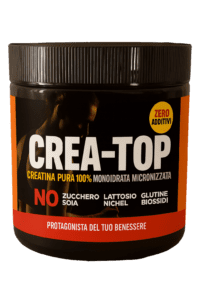
If you've decided to try it, here's the creatine I use and recommend, this is the link...CREA-TOP
And of course, if you decide to try it, let me know!
Oliver
Thank you Oliver
Thank you:)
I bought it last night and today I read your post! I'm trusting Dr. Tomasi! I've followed her challenges and now I'm starting the Soft Map Diet, I think it will be useful for my aerobic workouts!
Thank you very much for your trust! 💛 What a nice coincidence of timing, and we hope the post confirmed for you that it was a good choice.
A single helpful clarification, since you're talking about aerobic training: creatine performs best during short, intense efforts (sprints, climbs, strength work, changes of pace), rather than during continuous, prolonged aerobic exercise. This doesn't mean it's useless for aerobic training; it can still help with recovery between sessions and during the most intense phases of training, but it's good to have realistic expectations about where it performs best.
Good luck with the start of the Soft MAP Diet and with your training!
Good morning, I purchased this creatine from Doctor Tomasi. Can you confirm that it's better to take it every day and not just on days when I train? Thank you
Hello and thank you for your question. I am pasting my answer to a similar question below:
The short answer is: timing matters much less than you might think. What’s really important is taking it consistently every day, because the effect depends on gradually “saturating” your muscles over time, not on a single dose. So yes, you should take it every day, even on days when you don’t work out.
That said, two practical pointers:
On training days, if you want to follow the approach most supported by research, taking it after your workout seems to provide a slight added benefit (perhaps due to increased blood flow and the fact that it’s taken with your post-workout meal). It’s a speculative effect and modest at best, but if you have to choose a time, that’s the one.
On your days off, the exact time doesn't matter at all: just choose the time when you're most likely to remember to take it. Taking it with a meal can help a little with absorption and prevent any stomach upset, but it's not required.
In summary: every day, consistently; on training days, possibly afterward, but don't make a big deal out of it. Consistency beats perfect timing (which, incidentally, doesn't exist).
Greetings.
Thanks Oliver, thorough as always!
I do have a doubt: I'm not clear whether creatine should only be taken when training or every day...
Hello and thank you for your question. I am pasting my answer to a similar question below:
The short answer is: timing matters much less than you might think. What’s really important is taking it consistently every day, because the effect depends on gradually “saturating” your muscles over time, not on a single dose. So yes, you should take it every day, even on days when you don’t work out.
That said, two practical pointers:
On training days, if you want to follow the approach most supported by research, taking it after your workout seems to provide a slight added benefit (perhaps due to increased blood flow and the fact that it’s taken with your post-workout meal). It’s a speculative effect and modest at best, but if you have to choose a time, that’s the one.
On your days off, the exact time doesn't matter at all: just choose the time when you're most likely to remember to take it. Taking it with a meal can help a little with absorption and prevent any stomach upset, but it's not required.
In summary: every day, consistently; on training days, possibly afterward, but don't make a big deal out of it. Consistency beats perfect timing (which, incidentally, doesn't exist).
Greetings.
I didn't know anything about creatine. Thanks for the info.
Thank you:)
Good morning, Oliver. Thank you for your explanations. I’m currently dealing with very noticeable hair thinning, which is affecting my self-esteem. I’ve heard and read a lot about exosomes for the scalp, and I’d really like to hear your thoughts on the matter. Of course, if you could go into more detail, I’d appreciate it.
Have a nice day
Giovanna Diozzi
Good morning and thank you for the message, that's very kind.
In the meantime, one thing: the distress you describe is completely understandable and much more common than you might think. Hair loss affects self-esteem in a concrete way, and talking about it openly as you do is already a good starting point.
On exosomes for the scalp: it’s a genuinely interesting field. These are small vesicles released by cells that carry signals (proteins, growth factors, microRNAs), and the idea is to use them to “communicate” with the hair follicles and stimulate their activity. On paper, the biological rationale is sound. In practice, however, it must be honestly acknowledged that we are still in a very early stage: human studies are few, often small, and lack adequate control groups, and there is a lack of product standardization, agreed-upon dosages, and long-term safety data. Furthermore, in several countries, the regulatory status of exosomes for cosmetic use remains unclear, and this is an aspect that should not be underestimated when evaluating a treatment.
My sincere advice, before looking into emerging therapies, is to start with two things: a precise diagnosis (a dermatologist can tell if it's androgenetic alopecia, telogen effluvium, a deficiency component, or something else, because the cause completely changes the approach) and, where indicated, treatments with solid evidence behind them: minoxidil, finasteride, and some established procedures. Exosomes, today, I see more as a frontier to follow with curiosity than as a first choice to invest in.
I'm happy to reserve a dedicated piece of content to delve deeper into this topic, because you're touching on a question I get asked often.
Warm regards and have a great day, too.
I recently purchased it and I'm using it. I'll let you know over time, although I can already say that I have greater stamina in my daily tasks.
Thank you, Oliver, for the helpful explanation
Thanks for your feedback—it’s great to hear! 💪 That increased stamina in everyday activities is actually one of the first effects many people notice. Keep it up, and yes, let us know how it goes over time: feedback like yours is helpful to other readers, too.
Good morning, I bought it and would like to know how to take it (at what time of day) thank you
Hello and thank you for your question. I am pasting my answer to a similar question below:
The short answer is: timing matters much less than you might think. What’s really important is taking it consistently every day, because the effect depends on gradually “saturating” your muscles over time, not on a single dose. So yes, you should take it every day, even on days when you don’t work out.
That said, two practical pointers:
On training days, if you want to follow the approach most supported by research, taking it after your workout seems to provide a slight added benefit (perhaps due to increased blood flow and the fact that it’s taken with your post-workout meal). It’s a speculative effect and modest at best, but if you have to choose a time, that’s the one.
On your days off, the exact time doesn't matter at all: just choose the time when you're most likely to remember to take it. Taking it with a meal can help a little with absorption and prevent any stomach upset, but it's not required.
In summary: every day, consistently; on training days, possibly afterward, but don't make a big deal out of it. Consistency beats perfect timing (which, incidentally, doesn't exist).
Greetings.
Could I maybe have it as an afternoon snack, even though I don't go to the gym but just work cleaning stairwells every morning from 7 a.m. to 1 p.m.?
Good morning! Yes, absolutely. Creatine isn't just for gym-goers: your stair cleaning job is, in all respects, a demanding and repetitive physical activity. Climbing up and down, bending, carrying weights, staying active for six hours – so it fits perfectly into situations where it can help, both with endurance during your shift and with recovery.
One useful clarification, however: creatine isn’t a “snack” in the traditional sense, because it doesn’t provide nutrition or satisfy hunger like a meal or an afternoon snack. It’s simply a teaspoon of powder (3–5 g) to be dissolved in water, juice, or something similar, with no significant caloric value. So you can certainly take it in the afternoon, but it doesn’t replace a snack: if anything, you can take it along with something you eat or drink, which, by the way, helps with absorption a bit. The important thing, as we mentioned, is to take it consistently every day: the time of day doesn’t matter much—just choose the time when it’s easiest for you to remember.
Hi, when is the best time of day to take it, whether you're working out or not?.
Thank you
Hello, and thank you for your question.
The short answer is: timing matters much less than you might think. What’s really important is taking it consistently every day, because the effect depends on gradually “saturating” your muscles over time, not on a single dose. So yes, you should take it every day, even on days when you don’t work out.
That said, two practical pointers:
On training days, if you want to follow the approach most supported by research, taking it after your workout seems to provide a slight added benefit (perhaps due to increased blood flow and the fact that it’s taken with your post-workout meal). It’s a speculative effect and modest at best, but if you have to choose a time, that’s the one.
On your days off, the exact time doesn't matter at all: just choose the time when you're most likely to remember to take it. Taking it with a meal can help a little with absorption and prevent any stomach upset, but it's not required.
In summary: every day, consistently; on training days, possibly afterward, but don't make a big deal out of it. Consistency beats perfect timing (which, incidentally, doesn't exist).
Greetings.
Good morning,
Could you please tell me how I can figure out/find out my baseline creatine level?
I've been using your product for about a month.
Thank you
Sincerely
Good morning, and thank you for your question—it's an excellent one.
In short: To truly measure it requires a muscle biopsy or techniques like magnetic resonance spectroscopy—things typically done in research labs—so in practice, it’s not something we can determine. (I’ll just add that creatinine levels from blood tests aren’t useful for this purpose: they reflect too many factors at once.)
That said, there’s some good news: since you’ve been using it for about a month, at this point—regardless of your starting level—your stores should now be fully saturated (with 3–5 g per day, full saturation is reached in 3–4 weeks). So rather than “measuring your starting point,” what matters now is how you feel: energy and endurance during short, intense efforts, recovery between sets, and possibly a slight weight gain due to increased muscle hydration. These are the practical signs that the supplement is doing its job.
Thanks, Oliver, for all your explanations. I stopped going to the gym because of a shoulder problem that I hope to resolve soon, and I stopped taking your creatine, but I’ll start again, based on what I’ve read. Since it doesn’t dissolve very easily, can I take it with something hot or warm?
Grazie a te! Sì, puoi tranquillamente sciogliere la creatina in acqua tiepida o calda: la maggiore temperatura ne facilita la solubilità senza comprometterne l’efficacia.
Non è necessario utilizzare acqua bollente; basta che sia abbastanza calda da favorire lo scioglimento. Ti consiglio inoltre di berla poco dopo averla preparata, soprattutto se la mescoli con bevande acide, evitando di lasciarla sciolta per molte ore.
Puoi assumere la creatina anche durante il periodo in cui non vai in palestra: non sostituisce l’allenamento o la riabilitazione della spalla, naturalmente, ma può comunque aiutare a sostenere le riserve muscolari.
Thank you
Thank you
Buongiorno Oliver,vorrei provare ad assumere la vostra creatina soprattutto per migliorare il recupero muscolare, però assumo anche i map aminoacidi (8 compresse al giorno) , e non vorrei sovraccaricare troppo .
Mi saprebbe dare un consiglio?
Dimenticavo che soffro di ipotiroidismo e assumo il farmaco Tiche.
Grazie per la risposta.
Buongiorno e grazie per la domanda!
Può tranquillamente assumere la creatina insieme alle 8 compresse di MAP: la combinazione non comporta alcun sovraccarico in una persona sana.
I due prodotti svolgono funzioni differenti e complementari. I MAP forniscono gli aminoacidi essenziali necessari alla sintesi delle proteine, mentre la creatina aiuta i muscoli a rigenerare rapidamente energia, sostenendo forza, prestazione e recupero. Non è quindi necessario scegliere tra l’uno e l’altra.
Anche l’ipotiroidismo e l’assunzione di Tiche non rappresentano un problema: non sono note interazioni rilevanti tra levotiroxina, creatina e aminoacidi essenziali.
Tiche va semplicemente assunto secondo le indicazioni abituali, generalmente a digiuno e lasciando trascorrere il tempo prescritto prima di mangiare. Creatina e MAP possono poi essere assunti nel momento della giornata che risulta più comodo.
Per la creatina sono sufficienti 3–5 grammi ogni giorno, senza bisogno di effettuare una fase di carico. La regolarità è più importante dell’orario di assunzione.
Grazie per tutte le info , purtroppo io sono sempre un po dubbiosa su integratori e quant’altro.
Prendo quotidianamente solo magnesio faccio allenamento di forza 2 volte la settimana
Gli altri giorni non mi alleno vado a lavorare in bici , piccole passeggiate con cane
Lavoro 9/10 ore al giorno sempre in piedi ferma ( parrucchiera) e sono sempre di corsa.
Ha senso prendere creatina?… Grazie
Grazie a lei! Nel suo caso: sì, assumere creatina può avere assolutamente senso, anche se si allena con i pesi soltanto due volte alla settimana.
Due allenamenti di forza settimanali sono già sufficienti per ottenere benefici, e la creatina può aiutarla ad avere un po’ più di energia durante gli sforzi intensi, sostenere nel tempo forza e massa muscolare e favorire il recupero. Anche il suo stile di vita è tutt’altro che sedentario: si sposta in bicicletta, cammina e trascorre molte ore in piedi.
La creatina, inoltre, non è uno stimolante né una sostanza estranea all’organismo: il nostro corpo la produce naturalmente e la assumiamo anche attraverso carne e pesce. L’integratore serve semplicemente ad aumentare le riserve disponibili nei muscoli.
Può assumere 3 grammi di creatina monoidrato ogni giorno, compresi i giorni in cui non si allena. Non servono fase di carico, cicli o un orario particolare: è la regolarità a fare la differenza. Può continuare tranquillamente anche con il magnesio.
Naturalmente non deve aspettarsi un effetto eclatante da un giorno all’altro: i benefici sono generalmente graduali e consistono soprattutto in un piccolo ma concreto supporto alla prestazione, al recupero e al mantenimento della muscolatura nel tempo.